
Why the Water Goes Out for Days Here, and What to Do About It
Outages in Rosarito and Tijuana are not rare and not short. Why they happen, how your tinaco and pila carry you through one, and the part about delivered water that catches people out.
It is not a fault. It is how the system works, and it will happen to you.
New arrivals treat the first outage as an emergency and the second one as an outrage. People who have been here a while treat it as weather. The difference is preparation, not tolerance.
Why it happens
Northern Baja's water comes a long way, primarily from the Colorado River through an aqueduct system built decades ago. Infrastructure that old needs repair, and repairing a main line means shutting it off.
When that happens the shutdown is measured in days, not hours, and it affects large parts of Tijuana and Rosarito at once. Planned outages routinely run longer than announced. There have been repairs where hundreds of neighbourhoods were out for the better part of a week.
That is on top of ordinary local interruptions, which are more frequent and shorter. Pressure varies, and some areas are on rotating supply.
Why your house keeps working anyway, for a while
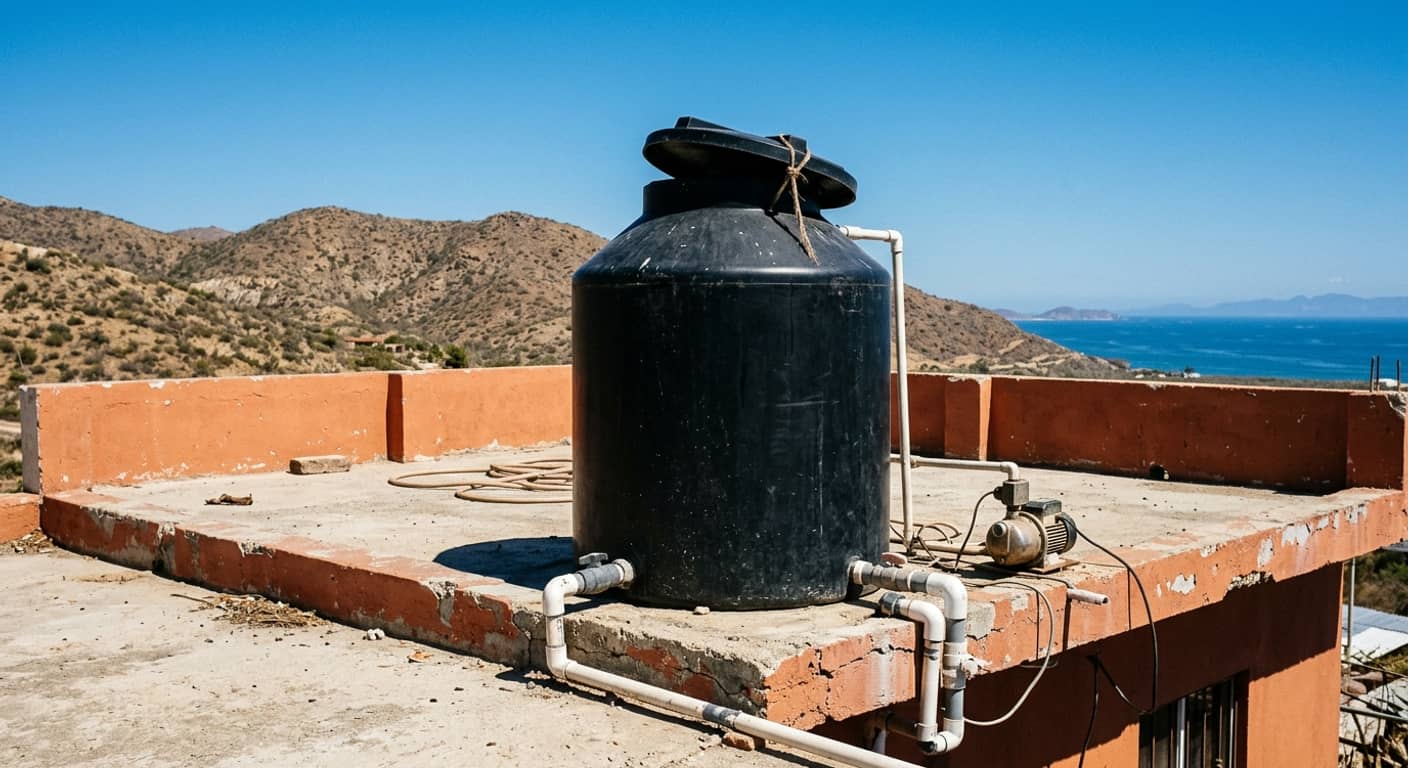
This is what the pila and the tinaco are for. The pila is the storage at or under the house, filled from the municipal line; a pump lifts water to the tinaco on the roof, which gravity-feeds your taps. Storage means the street can be dry while your taps are not.
How long you last depends on tank size and how careful you are. A family that does not change anything typically gets a couple of days. Stretch it and you get more.
The first thing most people learn is to check the tinaco level when they hear about an outage, rather than when the taps splutter.
The aguatero, and the part people get caught out by
When storage runs low, you call an aguatero, a water delivery truck, and they fill your pila. It is a normal part of life here, everyone has a number for one, and a delivery is not expensive.
Here is what almost nobody tells you: that water is not the same water. It comes from wells and local sources, treatment is not standardised, and nobody is inspecting the inside of the truck's tank between loads. It is fine for washing, flushing and showering. It is not water you should be drinking untreated, and it goes into the same pila that feeds your whole house.
So the day after an aguatero delivery, everything downstream of your storage is filled with water of unknown quality.
What happens to water while it sits
Whether it came from the street or from a truck, stored water changes while it waits:
- Chlorine fades. Whatever residual was in the water when it arrived dissipates over time in an open or vented tank. The longer water sits, the less is left.
- Sediment settles. Fine particles drop to the bottom of the tank and accumulate. Stir them up — with a pressure surge, a delivery, or a nearly empty tank — and they head straight for your pipes.
- Biofilm can grow. Tank walls that aren't cleaned can develop a slimy film where bacteria live, especially in a warm rooftop tank under the Baja sun.
None of this means your tinaco is dangerous by default. It means an unmaintained tinaco quietly undoes whatever condition the water arrived in. It is a big part of why clear-looking tap water still isn't treated as drinking water, a theme we return to in can you drink the tap water in Rosarito.
The outage itself creates a second problem
When supply is cut and then restored:
- The first water back through the lines often carries sediment, rust and air that were dislodged in the pipes.
- Pressure surges can stir up deposits both in the municipal lines and in your own storage.
If you've ever turned on a tap after an outage and seen cloudy or slightly brown water, that's what you're looking at. It usually clears after running for a bit — but during those windows, your stored and filtered water is what you want to rely on.
What this means for treatment
This is the argument for UV that has nothing to do with the city supply. Whatever ends up in your pila, from the street or from a truck, gets sterilized on the way to your taps — provided the treatment sits after the storage, which is where it has to go anyway.
Without it, an aguatero delivery means either going back to bottled water for a week or hoping.
It is also the argument for a spin-down prefilter. Delivered water carries more sediment than piped water, and a spin-down catches it before it reaches anything expensive.
Keeping your stored water clean
- Clean and disinfect your tinaco and pila regularly — about twice a year, more often if you see sediment or notice odor.
- Know your tinaco level and how to check it, and have an aguatero number saved before you need it.
- Flush your lines after an outage or a delivery by running a tap for a few minutes before you drink or cook.
- Filter at the point that matters. A whole-house filtration system with a spin-down prefilter captures sediment before it reaches your taps and appliances, and its carbon stages handle chlorine, taste, and odor for the whole house.
- Add UV for microbial safety. Because any chlorine residual fades in storage, UV sterilization is a strong final safeguard against bacteria — it's built into our whole-house systems.
- Use RO for drinking. For the water you actually drink and cook with, a reverse osmosis system at the kitchen gives you high-purity water regardless of what your tinaco is doing.
If you're deciding between treating the whole home and just the kitchen tap, our guide on whole-house versus under-sink filtration walks through it.
See what your stored water looks like
The only way to know how your storage is affecting your water is to test what comes out of your tap. Our free in-home water test measures your water on the spot — TDS, hardness, pH, chlorine, turbidity, UV transmittance, and a coliform screen — so you can see whether your tinaco is helping or hurting. If you want to know what you have just taken on after a delivery, that is a good moment to ask us.
Book your free water test, or message us on WhatsApp at 664 337 7023. We serve Rosarito, Tijuana, and the rest of Baja — no cost, no obligation.
Frequently asked questions
- How long do water outages last in Rosarito and Tijuana?
- Planned repairs are measured in days rather than hours and routinely run longer than announced. Hundreds of neighborhoods can be affected at once, on top of shorter local interruptions that happen more often.
- Why does Baja California store water in tinacos and cisterns?
- Municipal supply here is not always continuous — pressure drops, repairs happen, and some areas are on rotating schedules. Homes store water in a rooftop tinaco and usually a pila or aljibe at or under the house, so there is water available during a low-pressure period or an outage. It is a practical response to intermittent supply.
- Is aguatero water safe to drink?
- Not untreated. An aguatero is the delivery truck that fills your pila when storage runs low, and everyone here keeps a number for one. That water comes from wells and local sources, treatment is not standardised, and nobody inspects the inside of the truck's tank between loads. It is fine for washing, flushing and showering. It also goes into the same pila that feeds your whole house.
- How often should you clean a tinaco or cistern?
- A common guideline is to clean and disinfect rooftop tinacos and cisterns roughly twice a year, and more often if you notice sediment, cloudiness, or odor. After a water outage or a delivery it is also worth flushing your lines, since resumed supply can push sediment through the system.
- Does a water outage affect water quality when it comes back?
- It can. When supply resumes after an outage or repair, the first water through the pipes often carries sediment and air, and pressure surges can dislodge deposits in the distribution lines. Running a tap for a few minutes before drinking or filtering, and relying on your stored and filtered water during the outage, both help.
Want clean water in your home?
Book a free water test. We'll tell you exactly what your home needs — no obligation.
Get a Free Water Test