
Your Pila and Tinaco Are the Problem, Not the City Water
The water that arrives at your property is not the water that comes out of your tap. Understanding the storage chain explains almost everything about water quality in a Baja home, including where treatment has to go.
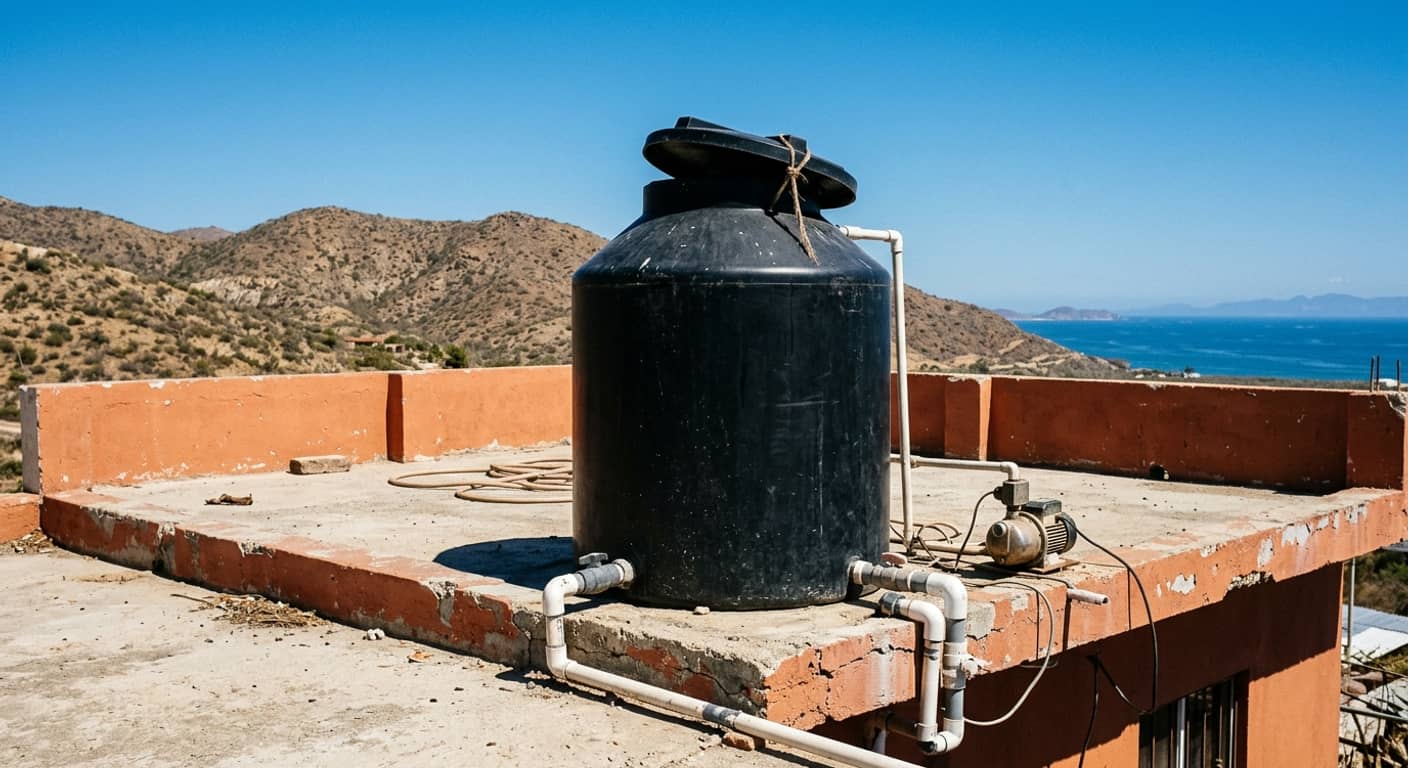
The water that arrives at your property is not the water that comes out of your tap. Something happens in between, and it happens at your house.
Almost every conversation about water quality in Baja starts in the wrong place. People ask whether the city water is safe. It's a reasonable question and it's the one every travel article answers.
It's the wrong question for a homeowner, because in most houses here the city water is not what reaches your tap. It's stored twice on your own property first — and that's where most of the problems we find actually begin.
Two tanks, both yours
North of the border, municipal water travels under continuous pressure from the treatment plant to the faucet. It doesn't stop.
Here, water arrives from the city — or by aguatero truck in areas without reliable service — and goes into the pila, the storage at or under the house. A pump lifts it from there to the tinaco on the roof, and the tinaco gravity-feeds the house.
Every house here has this arrangement because the city supply is not continuous. The storage is what lets you have water on a day when the street does not.
It is also why your water is not the city's water any more by the time you drink it. Two tanks, two opportunities for water to sit still, warm up and pick up whatever is in there, both on your property and neither inspected by anyone.
So there are really two separate questions about your water:
- What was its quality when it arrived from the city?
- What happened to it while it sat in your pila and your tinaco?
Question two is the one nobody asks, and it's the one that shows up in our test results.
What goes wrong in storage
Heat and sunlight in the tinaco. A tank on a Baja roof gets hot, and if it passes any light, that's a growth environment. Warm, still, lit water grows things. This is the single most common cause of the faint musty smell people describe.
Missing, cracked or ill-fitting lids. We find these constantly on both tanks. An open or poorly sealed tank takes in dust, roof grit, insects, lizards, bird droppings and airborne debris. Anything that lands on your roof eventually ends up in an open tinaco.
Sediment in the pila. Fine particles settle out and build a layer at the bottom. Disturb it — a refill, a pump cycle, a delivery — and it goes up to the tinaco and into the house. This is why water sometimes runs cloudy for no apparent reason.
Biofilm on the walls. A slick layer that forms on interior tank surfaces over time. It doesn't rinse off and it re-seeds the water continuously.
Stagnation. Whatever chlorine residual survived the trip from the plant dissipates while the water sits — first in the pila, then again in the tinaco. By the time it reaches your shower, whatever residual it had is largely gone.
Nobody cleaning either one. This is the big one. Both tanks need periodic cleaning. In practice, most don't get it. When we ask a homeowner when their tinaco was last cleaned, the most common answer is that they didn't know they had to. Ask around and you will find people who have owned a house here for a decade and never once opened either tank.
Why this changes what you should install
If you believed the problem was the municipal supply, an under-sink filter for drinking water would be a reasonable response. Filter what you drink, ignore the rest.
But if the contamination is happening in storage on your property, then it's in everything the house uses — the shower you stand under, the water your washing machine fills with, the tank of your water heater, the line to your ice maker, the tap you rinse vegetables in.
And it decides where the equipment goes. Treatment has to sit after the storage, on the line that feeds the house. Plumbing a filter onto the incoming line before the pila is the most common expensive mistake made here: the water is cleaned, then sent into the two tanks that were the problem in the first place. People do exactly that and then wonder why nothing improved.
That's also why whole-house filtration is normal here and unusual in the US. It isn't an upsell. It's a consequence of the plumbing.
For most homes on this coast that means three things working together at the point of entry, in order: a spin-down prefilter to catch the heavy grit that settled in the tanks, carbon filtration for chlorine, taste, odor and chemical contaminants, and UV sterilization last, so the final thing the water passes before it reaches a tap is a sterilizer. Anything living in the tinaco does not survive the trip to your kitchen. Skip the UV and you've stripped out the chlorine — the only disinfectant in the water — and replaced it with nothing. That's worse than no system at all.
Then, separately, reverse osmosis at the kitchen sink for drinking and cooking, because the standard for water you swallow is higher than the standard for water you shower in.
What about the city water itself?
Worth being straight about, because we can't verify it either.
CESPT supplies Tijuana, Playas de Tijuana and Rosarito, and it chlorinates. But it publishes no drinking water test results — their water quality page carries no compliance data you can review. Mexico's NOM-127-SSA1 sets the required limits, but there's no published figure showing what reached your neighborhood this month. And the system has fallen out of compliance before: during a 2020 chlorine shortage, CESPT's own quality control found delivered water in Tijuana with residual chlorine outside the standard. Supply isn't guaranteed either — an outage this past January left nearly 700 neighborhoods dry for more than five days, which sends homes to aguatero deliveries of unknown quality.
So the municipal supply is neither guaranteed nor verifiable. But even in the best case, water still has to survive your pila and your tinaco, and that part is entirely within your control.
What we'd suggest
Open both tanks and look. Not a figure of speech. Take the lid off the pila and off the tinaco. Most people have never done this, and it is the most informative five minutes available to you. Sediment on the bottom, discoloration on the walls, a lid that doesn't seal, anything living — you have your answer without a lab.
Find out when they were last cleaned. If the previous owner or landlord can't say, assume they haven't been. Every six months is the recommendation; most households manage every year or two.
Have the water tested at the tap. Testing at the meter measures what the city delivered. Testing at your kitchen sink measures what you actually drink. Only one of those matters.
Then decide. Sometimes cleaning the tanks plus a modest system is enough. Sometimes the tinaco needs replacing. Sometimes the existing system just needs filters it hasn't had in five years. The point is deciding from evidence rather than from a guess about the city.
Free water test
Baja Water Systems tests water at the tap for homes across Rosarito, Tijuana, Playas de Tijuana, Ensenada and Valle de Guadalupe. That reading is the water after the pila and the tinaco have had their turn with it, which is the only number that means anything. We tell you what's in your water, whether your storage is the cause, and what — if anything — you need. If the honest answer is "clean your tanks and check back in six months," that's what we'll tell you.
We test before we recommend. We only install systems we know will solve the problem.
Related reading
- Can you drink the tap water in Rosarito?
- Just moved to Baja? What nobody tells you about your water
- Why the water goes out for days here, and what to do about it
- Is your whole-house system still protecting you?
Want an answer for your own house? Book a free in-home water test — we test at your tap, in Rosarito, Tijuana, Playas de Tijuana, Ensenada and Valle de Guadalupe.
Frequently asked questions
- What is the difference between a pila and a tinaco?
- The pila is the water storage at or under the house, filled from the municipal line. The tinaco is the tank on the roof, filled by a pump from the pila, which then gravity-feeds the house. Both are the homeowner's responsibility and neither is inspected or treated by the city.
- Should filtration go before or after the storage tanks?
- After. The contamination happens in the tanks, so treating water before it reaches them does nothing about it. A filter plumbed onto the incoming line ahead of the pila is the most common expensive mistake here, and it is why people report that nothing improved after they installed one.
- How often should a pila and tinaco be cleaned?
- Every six months is the common recommendation here, and most homeowners go far longer than that, often a year or two, sometimes never. Sediment settles on the bottom and biofilm forms on the walls, so a tank that has not been opened in years is worth looking into before you assume the municipal supply is the problem.
- Why is my water dirty in Rosarito?
- In most homes the likeliest cause is the storage on the property rather than the municipal line. Water sits in the pila and the tinaco long enough for any chlorine residual to dissipate and for sediment and biofilm to build up, so what leaves the street main is not what arrives at the tap.
Want clean water in your home?
Book a free water test. We'll tell you exactly what your home needs — no obligation.
Get a Free Water Test