
Can You Drink the Tap Water in Rosarito? A Straight Answer.
No, and here's the part nobody tells you: the water is stored twice on your own property before it reaches your tap. A straight answer for homeowners in Rosarito and northern Baja.
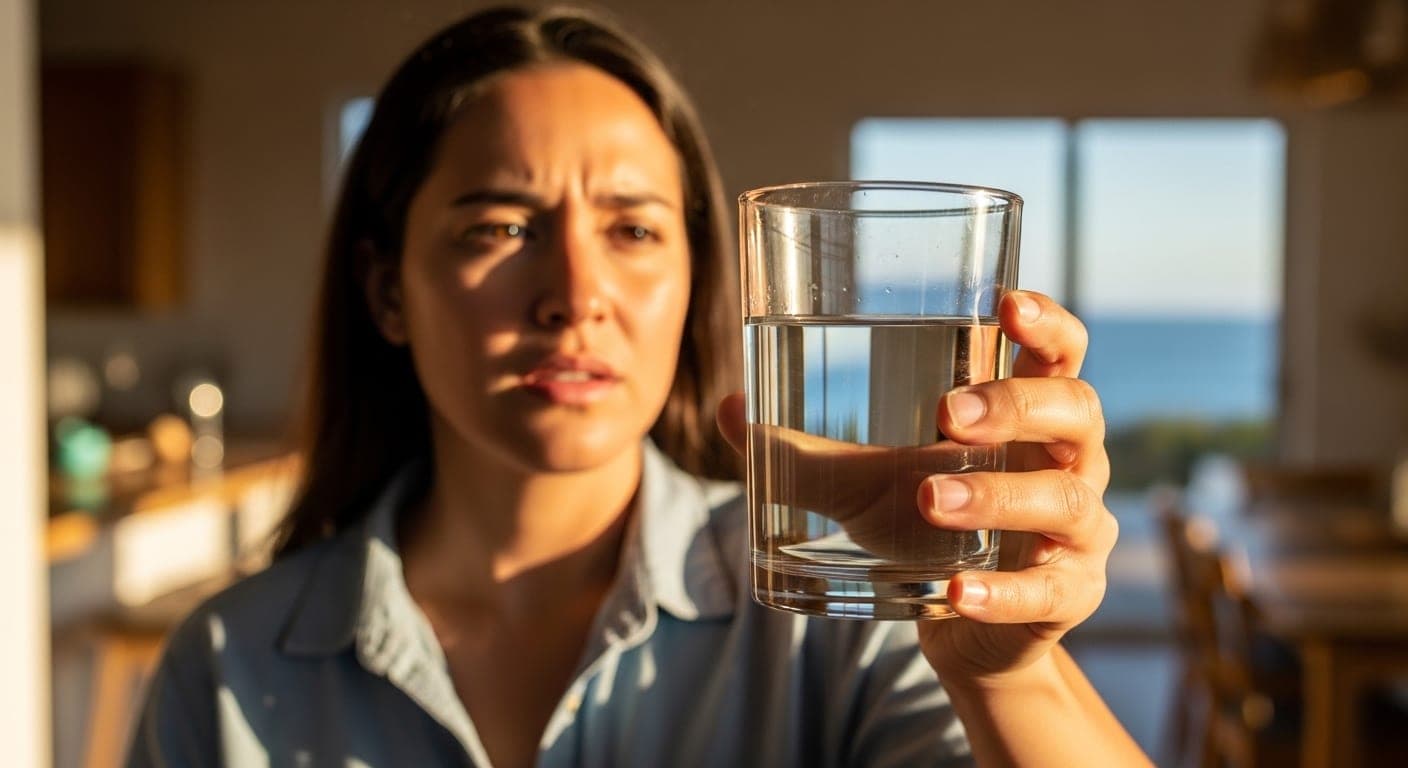
No — don't drink it untreated. But showering, washing and doing laundry with it is fine.
That's the short version, and it's the same advice you'll get from anyone who lives here. The longer version is the part almost nobody explains, and it's the part that actually matters once you own or rent a house in Rosarito:
The water that arrives from the city is not the water that comes out of your tap. In between, it sits in two tanks that belong to you.
How water actually reaches your faucet here
North of the border, municipal water travels under continuous pressure from the plant to the tap. The line is sealed and the water never stops moving.
A Baja house works differently. Water arrives from the city and goes into a pila — the storage at or under the house. A pump then lifts it to the tinaco, the tank on your roof, which gravity-feeds the house.
So your drinking water is stored twice, on your property, before you ever touch it. Nobody from the city inspects either tank. Nobody treats them. In a lot of houses, nobody has opened them in years.
When people ask whether Rosarito water is safe, they're usually asking about the wrong thing. The question that determines what comes out of your kitchen faucet is: what condition are your pila and tinaco in?
What we can and can't tell you about the city supply
Water for Tijuana, Playas de Tijuana and Rosarito comes from CESPT. Here's the honest position.
CESPT chlorinates the supply. But it publishes no drinking water quality results for public review — their water quality page carries no test data, no compliance reports, no potability statement you can check. Mexico's drinking water standard, NOM-127-SSA1, sets the limits suppliers are required to meet, but if you want to know whether the water reaching your street met those limits this month, there's no published figure to look up.
There's also documented history of the system falling out of compliance. During a 2020 chlorine gas shortage, CESPT's own quality control department found points in Tijuana where residual chlorine in the delivered water was outside the standard.
And supply itself isn't guaranteed. A CESPT outage this past January left nearly 700 neighborhoods without water for more than five days.
We're not going to tell you the city water is poison, and we're not going to tell you it's fine. We're telling you that nobody publishes the number — which is exactly why the only meaningful answer comes from testing the water at your own tap.
The practical rules people here actually follow
- Drinking and cooking: filtered or purified water only. Garrafones, or a properly installed drinking water system.
- Brushing teeth: most long-term residents use filtered water. The risk from a small amount is low, but it's the easiest habit to change.
- Showering and bathing: fine. Skin contact with municipal water is not the concern here.
- Laundry and dishes: fine, though hard water will leave scale on fixtures, in your water heater and in your washing machine over time.
- Ice: made from filtered water only. Freezing does not make water safe.
Why a jug under the sink isn't the whole answer
Buying garrafones solves drinking water and nothing else. If something is growing in your tinaco, it's also in your shower, your washing machine, your water heater and your ice maker.
There are three realistic paths. Garrafones — cheap, simple, and you are hauling and lifting them, and trusting a refill station you cannot inspect. Reverse osmosis at the kitchen sink — unlimited drinking water from a dedicated faucet, no bottles. Or whole-house filtration plus RO — every tap improved and the drinking water handled at the kitchen, which is the complete setup for a house you plan to stay in.
That's why whole-house filtration is common in homes here in a way it isn't north of the border: the risk is on your property, so the treatment has to be on your property too — at the point the water enters the house, not just at one faucet.
What to do in your first week
- Find both tanks and open them. The pila at the house and the tinaco on the roof. Sediment on the bottom, discoloration on the walls, a cracked or missing lid — that's your answer without a lab.
- Ask when they were last cleaned. Previous owners and landlords frequently don't know. That's informative in itself.
- Test the water at the tap, not at the meter. What matters is what's coming out after both tanks.
- Check any existing filtration. Many Baja homes have a system left by a previous owner that hasn't been serviced in a decade. An unmaintained filter can be worse than no filter at all.
Get an actual answer for your house
Every house on this coast is different — different storage, different plumbing, different age, different water. General advice only goes so far.
Baja Water Systems offers a free water test for homes in Rosarito, Tijuana, Playas de Tijuana, Ensenada and Valle de Guadalupe. We test what comes out of your tap, tell you what's actually in it, and tell you honestly what you need — including telling you when the answer is "nothing yet."
Baja Water Systems is a family-run water treatment company based in Rosarito. We test before we recommend, and we only install systems we know will solve the problem.
Related reading
- Your pila and tinaco are the problem, not the city water
- Is it safe to shower and brush your teeth with tap water?
- Whole house vs under sink filtration: which do you actually need?
Want an answer for your own house? Book a free in-home water test — we test at your tap, in Rosarito, Tijuana, Playas de Tijuana, Ensenada and Valle de Guadalupe.
Frequently asked questions
- Can you drink the tap water in Rosarito?
- No, not untreated. Showering, laundry and washing dishes with it are fine, but drinking and cooking water should be filtered or purified. The reason is less about the municipal supply than about the two storage tanks on your own property, the pila and the tinaco, which nobody from the city inspects or treats.
- Is the water safe to drink in Baja California?
- There is no published figure to answer that with. CESPT chlorinates the supply but publishes no drinking water quality results, and there is documented non-compliance with NOM-127-SSA1 during a 2020 chlorine shortage. The only meaningful answer for a specific house comes from testing the water at that tap.
- What is a pila and a tinaco?
- A pila is the water storage at or under the house, and a tinaco is the tank on the roof. Water arrives from the city into the pila, a pump lifts it to the tinaco, and the tinaco gravity-feeds the house. They are two different tanks and both belong to the homeowner.
Want clean water in your home?
Book a free water test. We'll tell you exactly what your home needs — no obligation.
Get a Free Water Test