
UV Water Filters: How They Work, and Why Ours Has No Lamp to Replace
How UV sterilization works, why it matters in Baja, and the maintenance most UV systems need. The UVF50 LED we install needs none of it.
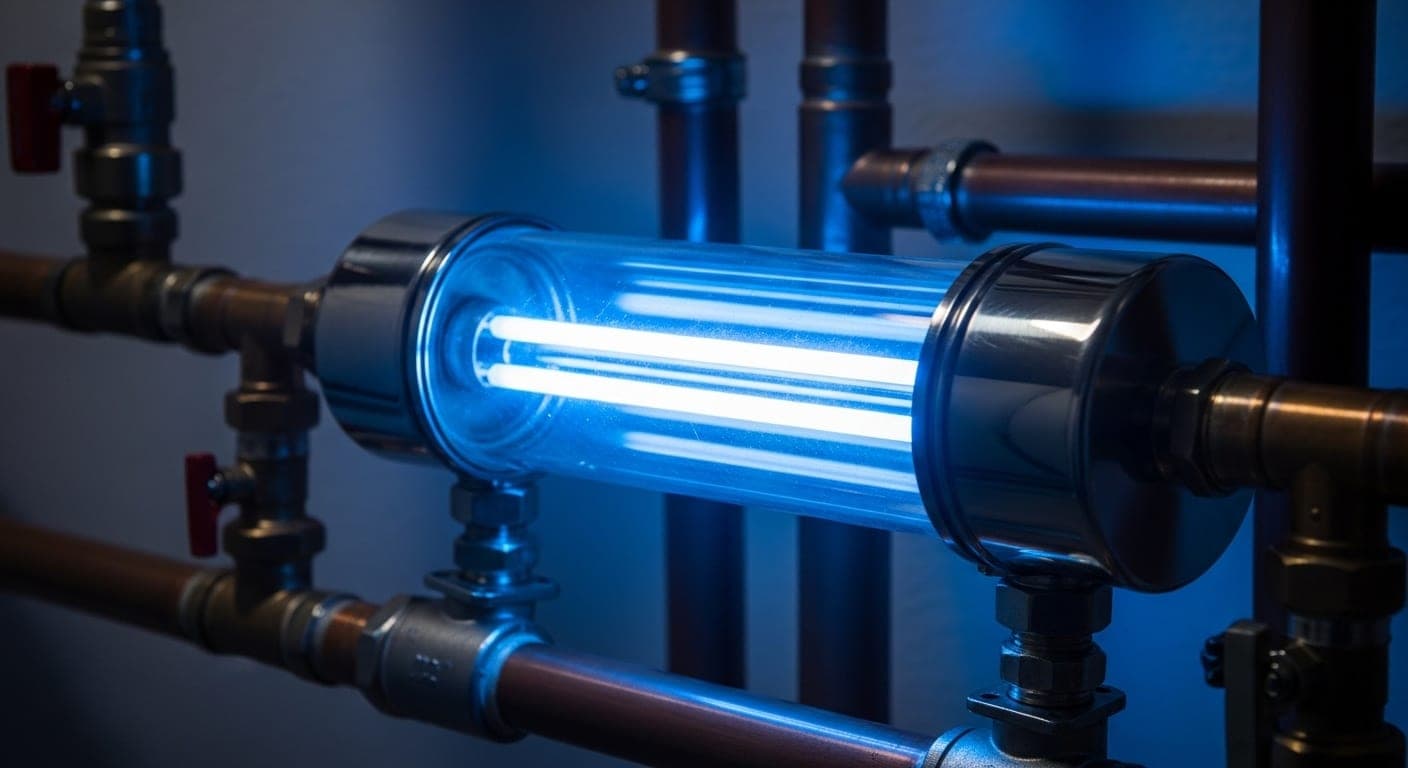
If filtration is the muscle of a home water system, UV is the immune system. It is quiet, it adds nothing to the water, and it handles the one thing carbon and sediment filters cannot: living microorganisms.
How UV sterilization works
Water flows through a chamber and past a source of ultraviolet light. As it passes, the UV-C light penetrates the cells of bacteria, viruses and protozoa and damages their DNA, so they can no longer reproduce or make you sick.
Three things make it worth having:
Nothing is added. No chlorine, no taste, no smell, no chemistry to manage.
Broad coverage. It works against a wide range of organisms, including some that shrug off chlorine.
Continuous. It works in real time as water flows. No contact tank, no waiting, nothing to remember.
Why it matters here specifically
Water in Baja does not go straight from the street to your tap. It goes into your pila, gets pumped to the tinaco on your roof, and sits there. A plastic tank in the sun, sometimes for days, sometimes with a lid that no longer seals.
Whatever protection the water had when it arrived is not what reaches your kitchen. UV puts a barrier back at the house, after the storage, which is why it is a standard stage on every whole-house system we install and why it always sits last in the line.
The one thing UV cannot do
UV disinfects. It does not clean.
Ultraviolet light has to reach the organism to work, and it cannot reach through sediment or cloudy water. A particle of silt is a hiding place. This is why UV is never installed on its own here: it goes after the spin-down prefilter and the filter housings, so the water arriving at the lamp is already clear.
A UV unit on dirty water gives you a light that is on and protection that is not there.
The maintenance most UV systems need, and why ours does not
This is where the older generation of UV units costs people money.
A conventional UV system uses a UV-C lamp inside a protective quartz sleeve. The lamp dims with age and has to be replaced roughly every year, whether or not it looks like it is working, because the light stays visible long after it stops being strong enough to kill anything. The quartz sleeve slowly films over with mineral scale and has to be pulled and cleaned. Miss either one and you have a system that looks fine and does nothing.
That is a yearly cost, a yearly job, and a yearly opportunity to forget.
The UVF50 LED we install has neither. No lamp to replace. No quartz sleeve to clean. It is mercury-free, and the indicator turns red when the unit stops working properly, so you find out from the unit instead of from a water test months later.
That is the whole reason we changed. Not because the older units did not work, but because a system that depends on somebody remembering an annual task will eventually be a system that is not protecting anybody.
What this means if you already have UV
If your system uses a lamp and a sleeve, those still need doing on schedule. Replace the lamp annually regardless of whether it still glows, and clean the sleeve when you do it.
If you are not sure what you have, or when it was last serviced, that is worth finding out before you rely on it.
Frequently asked questions
- How often do I need to replace a UV lamp?
- On a conventional UV system, about once a year. The lamp keeps glowing long after its output has dropped below the level that kills anything, so age is what matters, not whether it looks lit. The UVF50 LED we install has no lamp to replace.
- What is the quartz sleeve and why does it need cleaning?
- It is the clear tube protecting the lamp from the water. Mineral scale films over it and blocks the light. Conventional systems need it pulled and cleaned periodically. The UVF50 LED does not have one.
- Does UV remove sediment or chlorine?
- No. UV kills microorganisms and does nothing else. It has to be paired with sediment and carbon filtration, and it goes last, after the water is already clear.
- How do I know the UV is working?
- On the UVF50 LED the indicator turns red when it stops working properly. On older units there is often no warning at all, which is why the annual lamp change is not optional.
- Can UV be installed on its own?
- Not here. It needs clear water to work, and Baja water carries sediment. It goes after the prefilter and the filter housings, never before them.
Want clean water in your home?
Book a free water test. We'll tell you exactly what your home needs — no obligation.
Get a Free Water Test