
Buying or Renting in Baja? Check the Water Before You Sign
Water storage, supply reliability and inherited filtration are rarely inspected and can be expensive to fix. A short checklist to run before you commit to a property in northern Baja.
Water is one of the few things about a Baja property that is genuinely expensive to fix after the fact and almost never appears in an inspection.
Structural issues get looked at. Roofs get looked at. Water storage, supply reliability and whatever filtration the last owner installed usually don't — and all three are yours the moment you sign.
This is the short list. It takes fifteen minutes during a viewing.
1. How does water get to this property?
Three possibilities, and they aren't equivalent:
- Municipal supply into on-site storage — pila at the house, tinaco on the roof. Most common in town.
- Aguatero delivery — water trucked into the pila. Common in areas without reliable service. It's a recurring cost and a scheduling obligation, and delivered quality varies by supplier.
- A well. Common in Valle de Guadalupe and rural areas. Water quality is entirely property-specific and can include hardness, iron and contamination that municipal water doesn't have.
Ask directly. "Municipal" and "aguatero" are very different ongoing situations and sellers don't always volunteer which one applies.
2. Look inside both tanks
Ask to see the pila at the house and the tinaco on the roof, and take the lids off.
You're looking for sediment on the bottom, discoloration or biofilm on the walls, cracked or missing lids, and any sign that things have been getting in. A tank that hasn't been opened in years usually looks like it.
Also ask capacity. It determines how long the house keeps running when supply is interrupted — a CESPT outage this past January left nearly 700 neighborhoods dry for more than five days, and tank capacity was the difference between noticing and not.
3. Ask when the tanks were last cleaned
The most common answer is that nobody knows. That is itself the answer, and it's normal — tank cleaning is one of those maintenance items that quietly doesn't happen.
It's not a reason to walk away. It's a cost to know about, and reasonable to raise in negotiation.
4. Identify any existing filtration — and its age
Many properties come with a system. Ask three questions:
- What is it? Whole-house, drinking water only, softener, UV, or a combination.
- When was it installed? Ten to fifteen years is very common.
- When were the filters and UV lamp last changed?
That third question matters most. An unmaintained system is worse than no system: a saturated carbon cartridge can release what it previously captured, and a UV lamp past its service life still lights up while delivering a fraction of its rated dose. The glowing blue light is not evidence of anything.
Budget for either servicing it or replacing it, and don't let "the house has a water system" reassure you until you know its condition.
5. Check the pressure and the pump
Run taps. Run two at once. Weak or wildly varying pressure usually points at the pump or the storage configuration, and pumps are a real replacement cost.
If the system is gravity-fed from the roof tinaco, upper-floor pressure is a known limitation worth testing before you're living with it.
6. Look for hard water damage
White scale on shower heads, taps and glass doors tells you about mineral content. So does the condition of the water heater, if you can see it.
Hardness isn't a safety problem, but it shortens the life of every appliance that touches water. In a house you're buying, that's a real number.
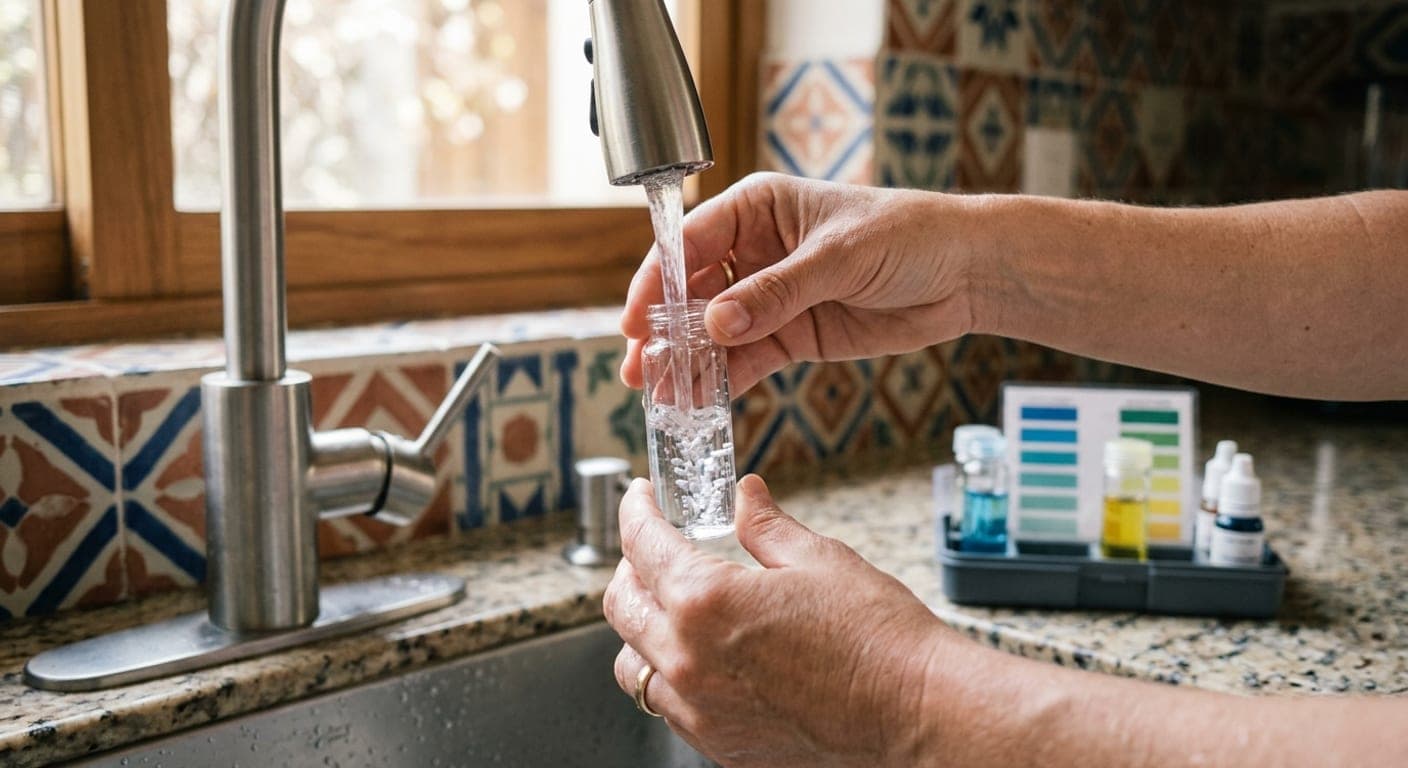
7. Test the water at the tap
The single most useful thing you can do, and the one people skip.
Testing at the meter tells you what the city delivered. Testing at the kitchen tap tells you what you'll actually be drinking, showering in and washing with — after storage, after plumbing, after whatever the existing system is or isn't doing.
For agents
If you represent buyers on this coast, this checklist is worth having. Water is one of the few areas where a client can have an unpleasant surprise in month two that a fifteen-minute look during a viewing would have caught — and being the agent who raised it is a good position to be in.
We'll test water at a property for a client at no charge. If it's clean, we say so.
Free water test before you commit
Baja Water Systems tests at the tap across Rosarito, Tijuana, Playas de Tijuana, Ensenada and Valle de Guadalupe. We'll tell you what's in the water, what condition the tanks are in, whether the inherited system is doing anything, and what it would cost to put right.
We test before we recommend. If the answer is that you don't need anything, that's what we'll tell you.
Related reading
- Just moved to Baja? What nobody tells you about your water
- Your pila and tinaco are the problem, not the city water
- Is your whole-house system still protecting you?
Want an answer for your own house? Book a free in-home water test — we test at your tap, in Rosarito, Tijuana, Playas de Tijuana, Ensenada and Valle de Guadalupe.
Frequently asked questions
- What should I check about water before buying a house in Baja?
- Open the pila and the tinaco and look inside, ask when they were last cleaned, ask how reliable supply is on that street, and establish what any existing filtration is and when it was last serviced. None of this is usually covered by an inspection.
- Is water supply included in a Mexican home inspection?
- Typically not in any depth. Storage tanks, supply reliability and inherited filtration are rarely examined, which is why they are worth checking yourself before you commit.
- What questions should I ask a landlord about water in Baja?
- Who cleans the pila and tinaco and when they were last done, how often supply is interrupted on that street, whether the house has ever been filled by an aguatero truck, and what the existing filtration is and who services it.
Want clean water in your home?
Book a free water test. We'll tell you exactly what your home needs — no obligation.
Get a Free Water Test