
A water filtration system installed and forgotten is not a water filtration system — it’s a false sense of security. Every component in a properly designed whole-house system has a service life, and when those lifespans are exceeded, performance degrades in ways that aren’t always visible until the problem is significant.
Here’s what needs to be maintained, on what schedule, and what happens when it isn’t.
Filter Cartridges
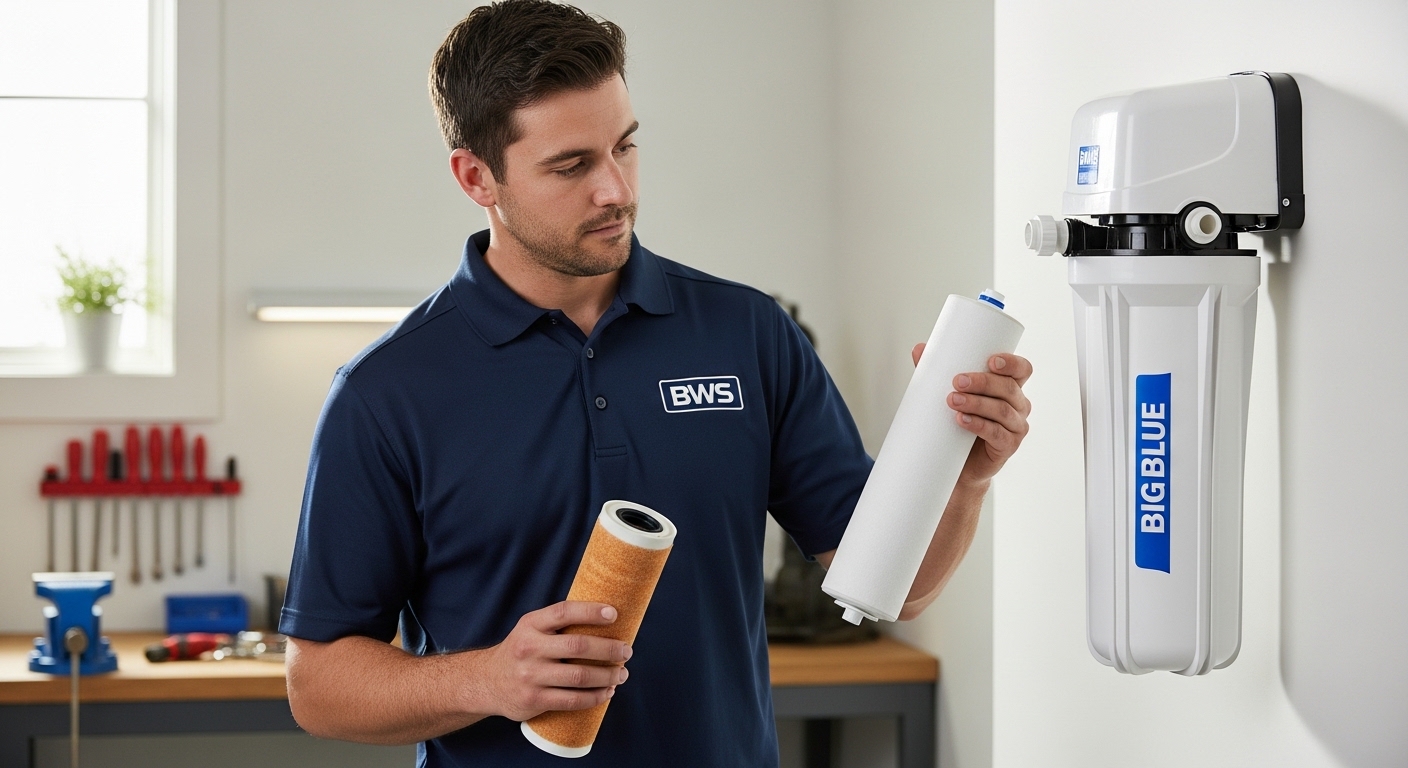
Sediment and carbon filter cartridges have a finite capacity. As they accumulate particles and contaminants, differential pressure across the housing increases, flow rate drops, and eventually the cartridge becomes a source of contamination rather than a solution to it. A saturated carbon cartridge can begin to release the contaminants it previously captured.
For most homes in Rosarito on municipal supply with a cistern, cartridge replacement every 6 months is appropriate. Homes on more turbid supply or with higher usage may need changes more frequently.
How do you know when it’s time? A pressure gauge installed across the filter housing tells you. We include one in every installation and check it at every service visit.
UV Lamps
This is the most commonly neglected component in any UV-equipped system — and the most consequential to overlook.
UV lamps don’t burn out the way a household bulb does. They gradually lose output over time. Most residential UV lamps are rated for approximately 9,000 hours of continuous operation — roughly one year. After that, they may still appear to glow but are no longer delivering the UV dose required for effective sterilization.
An expired UV lamp means your system is filtering water but not sterilizing it. The lamp should be replaced annually regardless of whether it appears to be working.
RO Membranes and Filters
An under-sink RO system has its own service schedule. Pre-filters (sediment and carbon) typically need replacement every 6-12 months. The RO membrane itself lasts 2-3 years under normal conditions. Post-carbon filters should be replaced annually.
A declining RO membrane shows up as rising TDS in the output water. We check this at every service visit with a calibrated meter. When TDS climbs, it’s time to replace the membrane.
What Gets Checked at Every BWS Care Visit
- Differential pressure readings across all filter housings
- UV controller status and lamp hours logged
- Quartz sleeve inspection and cleaning
- RO output TDS reading vs. baseline
- Leak inspection at all fittings and connections
- Sanitizer flush if needed
- Updated service log with next-due date sticker
The BWS Care Plans
Our maintenance plans are structured around visit frequency — Annual, Semi-Annual, Quarterly, and Monthly for commercial or high-use installations. Filter cartridges, UV lamps, and RO filter sets are included within the plan, so there are no surprise parts bills at service time.
The goal is simple: your system should work exactly as well in year three as it did on installation day. That only happens with consistent maintenance.
If you have an existing system — installed by us or anyone else — and you’re not sure when it was last serviced, that’s the right place to start.