
If you’ve just moved to Rosarito — or you’re managing a property here — one of the first questions you’ll ask is: what’s actually in the water?
The short answer: it depends. Baja water quality varies significantly by neighborhood, season, and whether your home uses a cistern or tinaco. What’s coming out of the street feed in one colonia can be very different from what reaches your kitchen tap two blocks away.
Here’s what we find in most homes we test:
Common Water Problems in Rosarito
Chlorine and Chloramines
Municipal water in Baja is treated with chlorine — which is good for killing bacteria but leaves a taste and odor that most people find unpleasant. In older distribution systems, chloramines are also used and these are harder to remove than standard chlorine.
Sediment and Turbidity
Cisterns and tinacos accumulate sediment over time. Even a well-maintained tank can introduce particles into your water that affect taste, appearance, and the lifespan of appliances and fixtures.
Bacteria and Coliform
This is the one that matters most for health. Cistern contamination from roof debris, cracked lids, or infrequent cleaning can introduce bacterial contamination that no amount of chlorine necessarily addresses by the time water reaches your tap.
Hardness
Baja groundwater tends to be moderately hard. This isn’t a health issue but it accelerates scale buildup in water heaters, showerheads, and appliances — shortening their lifespan.
Why a Water Test Matters Before You Buy Anything
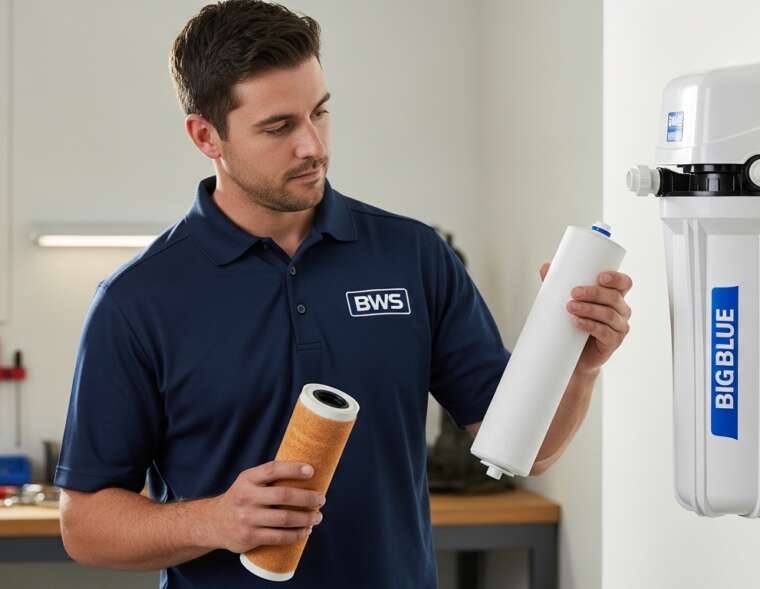
Every home we service starts with a test — not a sales pitch. We measure hardness, free and total chlorine, TDS (total dissolved solids), turbidity, UV transmittance, and run a coliform screen on the spot.
The results tell us exactly what your water needs. Sometimes that’s a simple whole-house carbon filter with UV. Sometimes an RO system under the sink makes sense for drinking water. Sometimes both. But we never recommend equipment before we know what we’re dealing with.
What a Whole-Home System Actually Does
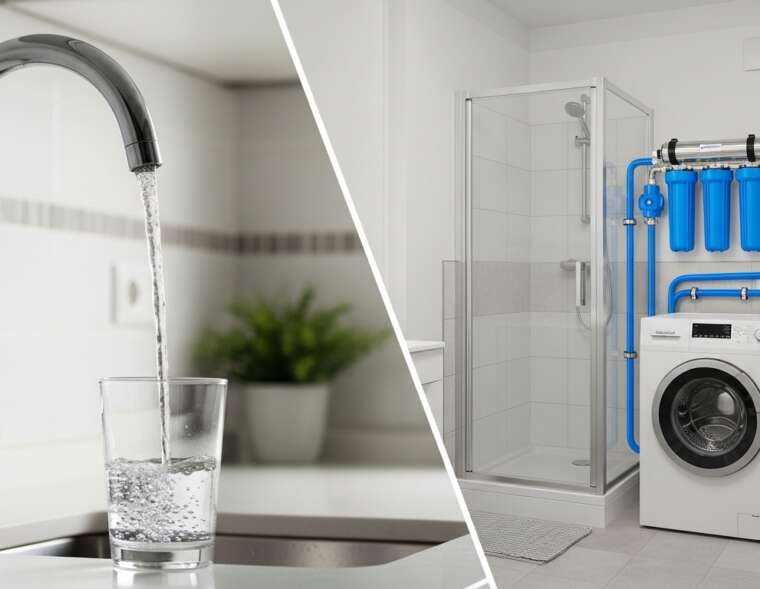
A properly sized whole-house filtration system handles sediment, chlorine taste and odor, and UV sterilization at the point where water enters your home — before it reaches any tap, shower, or appliance. That means cleaner water everywhere, not just the kitchen.
For drinking-quality water, an under-sink reverse osmosis system adds a final layer of
purification that removes dissolved solids, heavy metals, and residual contaminants down to the parts-per-billion level.
The Bottom Line
Baja water isn’t necessarily unsafe — but it isn’t uniform, and the conditions that affect quality change over time. The right answer for your home depends on your source, your plumbing, and your usage. A test tells you exactly where you stand.
If you want to know what’s in your water before you spend anything on equipment, start there.